Before the first foundation is ever poured in a new neighborhood, heavy civil construction has already spent months laying the groundwork and infrastructure you rely on every day. It’s the road you take to get home, the water line running beneath your street, and the site prep that makes a plot buildable in the first place.
Simply put, heavy civil construction drives the infrastructure that makes modern life work. Highways and interchanges, airport runways, major utility networks, and the ground beneath entire subdivisions all fall under this umbrella.
What is Heavy Civil Construction?
If you’ve ever driven past a fresh job site buzzing with massive excavators and bulldozers, you’ve seen heavy civil construction in action.
While general commercial construction centers on vertical structures, heavy civil focuses on the horizontal world: the earth, the access routes, and the subterranean systems underneath them. In fact, a heavy civil project can stand entirely on its own without a building ever entering the blueprint.
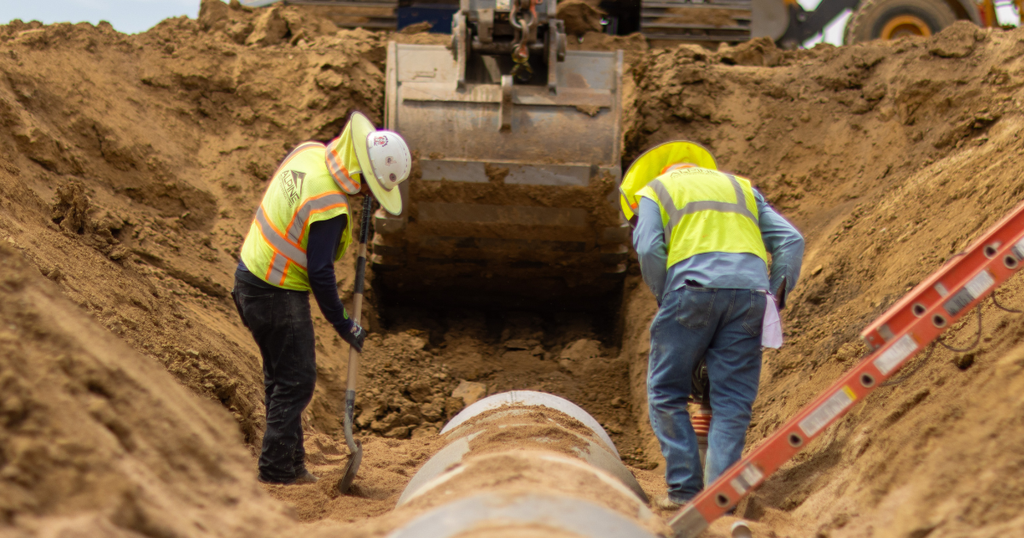
What really defines heavy civil is how many moving parts it takes to bring a site to life. On any given site, a team integrates multiple specialized disciplines at once:
- Earthwork & Grading: Excavating massive volumes of earth to establish precise contours and stable site elevations.
- Underground Utilities: Installing crucial stormwater drainage, main line sewer trunklines, and water distribution networks.
- Paving & Concrete: Building durable roadways, curbs, sidewalks, and reliable sub-bases.
- Logistics & Support: Coordinating surveying and topography, heavy trucking, land clearing, and site stabilization simultaneously.
It’s a balance of heavy machinery, specialized engineering, and clear coordination.
How Does Heavy Civil Construction Differ from General Construction?
While both industries shape the built environment, their focus, scale, and execution methods set them apart:
| Heavy Civil Construction | General Construction |
| Builds and improves large-scale infrastructure | Builds or renovates individual structures |
| Roads, bridges, utilities, airports, and major earthwork | Homes, offices, schools, retail spaces, and warehouses |
| Spans large areas with extensive excavation, grading, or paving | Usually confined to a defined, single building site |
| Driven by civil & geotechnical engineering, GPS machine control, and heavy fleet logistics | Driven by architectural design, structural framing, and interior trades |
While the scope can occasionally overlap on complex job sites, the key distinction comes down to focus. Heavy civil construction is centered on the ground, site access, utilities, roadways, and infrastructure beneath the surface. General construction typically follows once that groundwork is in place, focusing on the buildings and structures constructed above it.
Who Uses Heavy Civil Construction?
Because heavy civil construction supports the infrastructure communities rely on, its clients are typically large-scale public and private entities. These often include municipalities, state and local agencies, airports, utility providers, major land developers, and large commercial or industrial organizations.
Public Sector & Municipalities
Cities and state agencies rely on heavy civil contractors to build and upgrade highways, water systems, and public infrastructure. These projects require navigating strict specifications, formal bidding processes, and multi-layered approvals.
Airports & Transit Hubs
Few environments demand as much coordination as an active airport. Expanding runaways or concrete aprons means balancing heavy equipment, tight timelines, and strict safety protocols without disrupting daily operations.
Private Developers
On a large residential or master-planned community, homebuilders can’t move forward until the infrastructure beneath the dirt is fully operational. You can’t build a neighborhood without first building what makes the neighborhood work.
What Does Heavy Civil Construction Include?
While heavy civil construction encompasses several core scopes, the sequence matters just as much as the individual trades. Earthwork establishes the ground, the shape of the land as well as the flow of water from high to low, underground utilities are set deep within it, and paving seals the surface above.
If the work underneath is wrong, covering it up doesn’t make the problem disappear.
Earthwork and Site Grading: Establishing Proper Site Elevations and Drainage
Everything starts with the ground.
Before heavy machinery ever moves a yard of dirt, crews analyze soil conditions to identify unstable material and drainage risks early, well before they turn into costly delays. From there, earthwork establishes site elevations, drainage patterns, slopes, road subgrades, and building pads.
Get the grade wrong here, and the error doesn’t stay in the dirt. It carries into the utilities, concrete, asphalt, drainage, and every scope that follows.
A properly prepared site is built to perform for decades. Poor site preparation, however, often reveals itself over time through settlement, shifting, drainage problems, pavement failure, and other costly structural issues.
Precision at this scale requires modern technology.
Rather than relying solely on traditional survey stakes, stringlines, and manual grade checks, Alpine begins the process in the office during preconstruction. Our team uses digital design files, 3D modeling, and project engineering data to plan the work before equipment reaches the field. These models are then used with GNSS machine-control technology to give operators real-time positioning and elevation guidance directly in the cab. This allows our crews to grade more efficiently, maintain production, and build to the exact engineered design.
That level of accuracy is essential when terrain works against you.
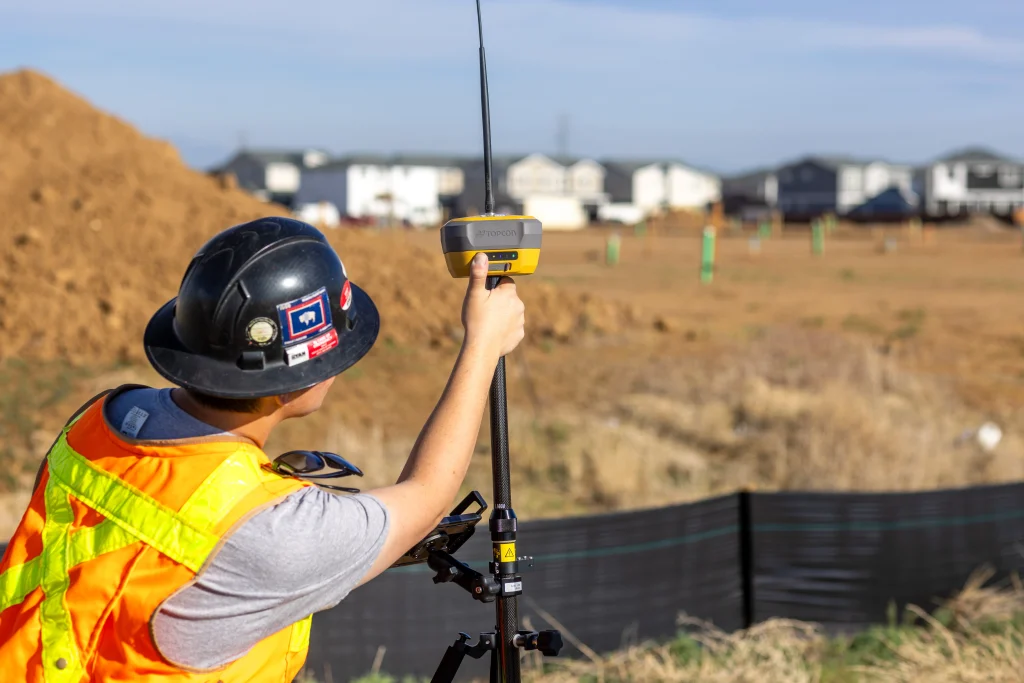
On projects like The Oaks of Castle Rock, a 170-acre residential development set on steep, uneven Front Range terrain, a single grading error in one section can throw off the entire site. High-tech precision during earthwork ensures the crews coming in behind it don’t have to compensate for a problem they didn’t create.
Underground Utility Installation and Upgrades
Once the site begins taking shape, underground infrastructure has to go in before final grades and finished surfaces seal everything up. This phase includes installing water mains, sanitary sewer systems, storm drainage, and system updates for existing infrastructure.
Because this work is backfilled and hidden from sight, precision is critical. Sanitary and storm sewers rely on exact gravity slopes to move water and waste effectively. An offset of just a fraction of an inch might be hidden under dirt today, but it can surface years down the road through backups, site settlement, or pavement failure.
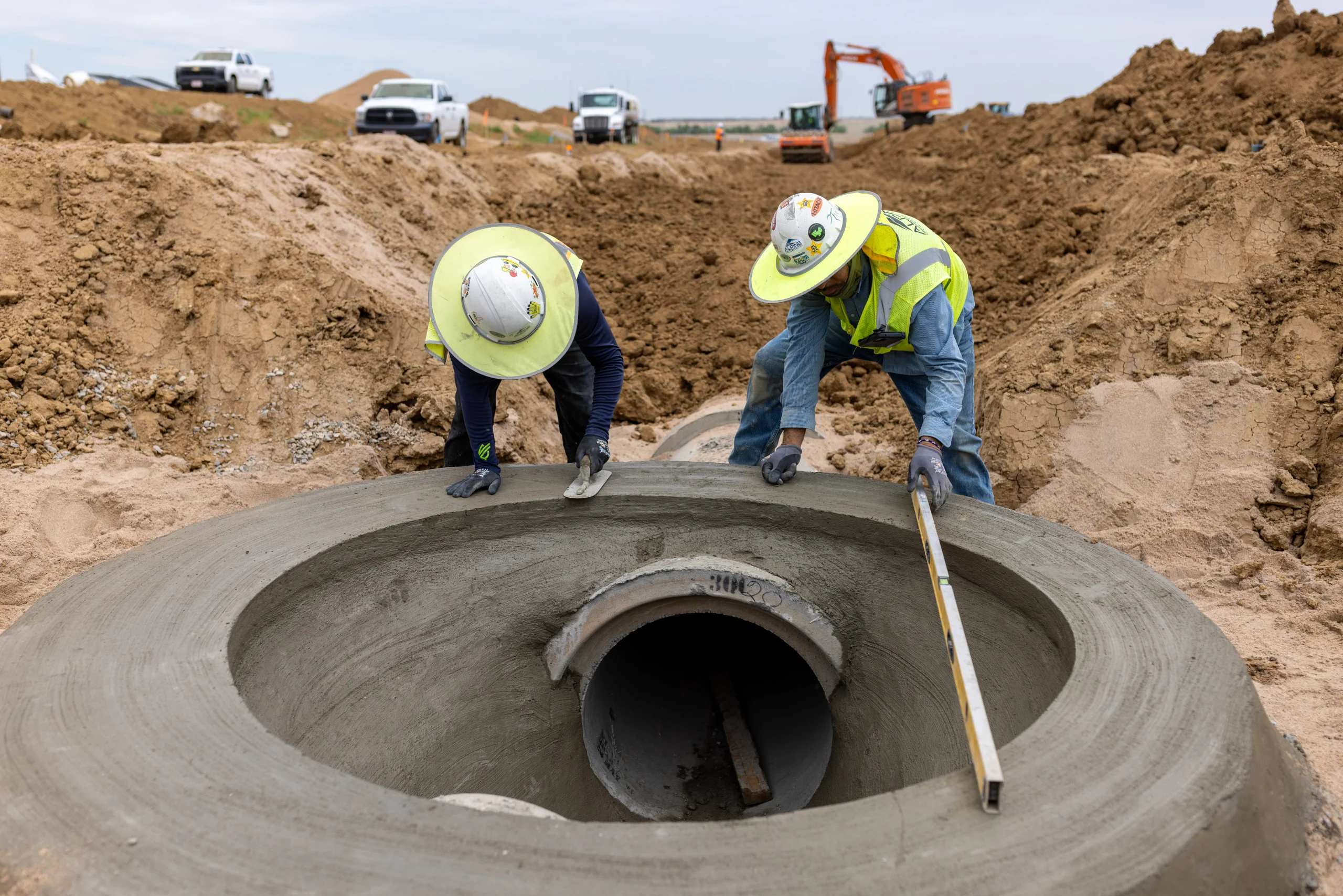
At The Poudre Canyon Raw Waterline Replacement in Bellevue, the waterline itself was at the center of the project rather than a scope within a larger project. Alpine handled the extensive earthwork and precision concrete work required to install the massive pipe through rugged terrain, setting up a system designed to perform seamlessly out of sight for decades.
Whether utility work is a single step in a master-planned community or the focus of a rural infrastructure upgrade, the principle remains the same. Most people will never see the finished product, but everyone will notice if it isn’t done right.
Precision Concrete Flatwork and Structures
Concrete flatwork includes curbs, gutters, sidewalks, ramps, and drainage structures. By the time concrete is being poured, months of earthwork and underground utility installation have already taken place beneath their feet.
And concrete doesn’t leave much room to hide a mistake.
Once concrete sets, fixing a wrong slope or elevation can mean tearing out the entire section and starting over. A gutter poured incorrectly holds water instead of directing it, while a drainage inlet set off-grade can miss the very runoff it was built to collect.
Precision matters down to fractions of an inch.
To maintain that exactness, Alpine uses Topcon Millimeter GPS® technology on our concrete projects. Instead of relying solely on physical stringlines, our crews connect directly to the project’s 3D digital model to control both horizontal and vertical positions in real time during the pour.
The difference becomes obvious at scale.
With millimeter GPS, we were able to pour 10,000 linear feet of sidewalk in three days. If we did it the old way, that would have taken nearly two weeks.
Seth Aberle, Machine Control Specialist, Alpine Civil Construction
On massive projects like Denver International Airport, where earthwork, utilities, concrete, and paving all interlock, that speed and accuracy are crucial. A single mistake that forces a tear-out doesn’t just impact the concrete crew; it can push back timelines for every other trade on site.
Asphalt Paving and Final Surface Work
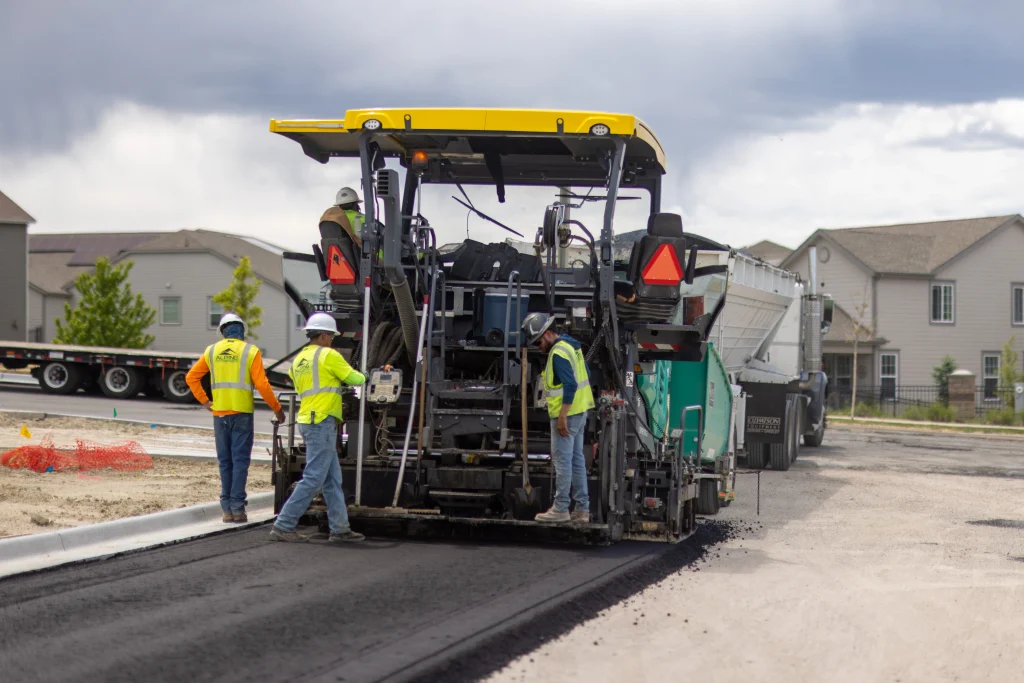
Because asphalt is often the final material placed on a project, it can be easy to view the pavement as the finished product. In reality, asphalt is only the final layer of a much larger construction process. Its long-term performance depends on everything beneath it being built and placed correctly, including subgrade preparation, drainage, utility installation, aggregate base, grading, and compaction
Heavy civil paving can include new road construction, lane widenings, intersection improvements, and resurfacing. Asphalt creates a smooth driving surface, but it also helps protect the base and subgrade beneath it from water intrusion while accommodating traffic loads and temperature shifts.
A pothole that seems to appear overnight rarely starts overnight. The cracking on top is usually just the final symptom of a weakness deep underground.
That’s why good paving starts well before the paving crew arrives.
That’s why durable paving relies on the quality of the groundwork underneath. Asphalt can only perform as well as the sub-base supporting it.
The 37th Street Widening project in Evans illustrates how paving fits into the larger picture. The project transformed a two-lane signalized intersection into a four-lane roundabout while also adding sidewalks and making storm sewer and waterline improvements.
The road wasn’t a separate project from the utilities, drainage, grading, and concrete. It was the finished result of all those trades working together.
End-to-End Scope Integration and Execution
Earthwork, utilities, concrete, and asphalt are only part of the heavy civil picture.
Surveying establishes the control points and data everything else is built against, trucking keeps materials moving efficiently, and landscaping restores disturbed ground to handle long-term drainage once heavy machinery leaves the site.
Every scope directly impacts the next.
On a traditionally structured project, those phases are split among several independent contractors, each operating on their own schedule and interpretation of the plans. Every handoff creates a potential gap where communication can slip, timelines can stall, or minor errors can compound.
Alpine takes a different approach by self-performing our civil scopes in-house.
The same team responsible for grading the site can also install its utilities, place its concrete, and pave its roads. Because our crews work from the same project information, site transitions are seamless.
Understanding What’s Beneath Every Project
Most people don’t think much about heavy civil construction once the work is finished, and that’s usually the point.
You drive the road without thinking about its subgrade. You turn on the tap giving a second thought to the water main beneath the street. You walk through a neighborhood without realizing thousands of cubic yards of dirt were moved to make the elevations work.
But nothing built above ground can stand for long without reliable infrastructure underneath it.
Heavy civil construction prepares the ground, installs the systems, and creates the connections that make everything else possible. If you’ve got a project on the horizon, reach out to us to talk about what we can build together.